Shortly after her arrival in Spain, Leone Moats attended the Seville fair. The fair was first held in 1847 and is held two weeks after Easter. In 1943, it would have occurred in early May. While at the fair, Moats attended a ball hosted by the Duke of Alba. Alba, who served as Franco's ambassador to Britain, was a descendant of King James II and had been educated in England. He had also served in the cabinet of Alfonso XIII, whose flight from Spain had led to the formation of the Second Republic. He was politically and socially prominent. In short, his party was a big deal.
Moats reports that:
Naturally, there were hundreds of rumors about the ball. It was said that the Duke had taken over the principal hotel in Seville, the Andalusia Palace, to house his guests;. . that several planeloads of important personages were going to arrive from London especially for the occasion; . . . that he was giving it to cement relations with England; that it was to be a costume ball with everyone wearing clothes copied from Goya paintings. The last rumor was taken quite seriously by several people who spent thousands of pesetas having Balenciaga run up magnificent creations for them. The dresses were already started by the time they discovered that it was not a costume ball.At the ball, she encountered the legendary flamenco dancer Pastora Imperio. By this time, Pastora was in her mid fifties. Moats writes:
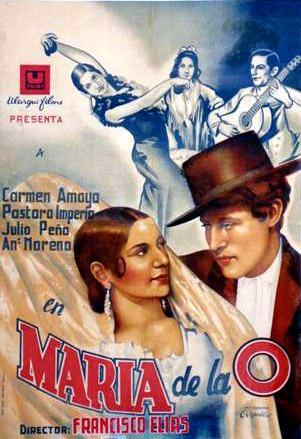
[Guests] wandered through the patios and gardens where the trees were hung with red lanterns and the hedges gleamed with concealed lights. They went from the dance floor built in the corner of the garden, where an orchestra played waltzes, to the ballroom, where a colored band played jazz. When they grew tired of dancing, they moved up to another corner of the garden where gypsies danced and sang and old women hung over big cauldrons of boiling oil containing churros (a kind of doughnut). They went upstairs to the long drawing room where, on a temporary stage, a gypsy troop headed by the old favorite, Pastora Imperio, performed.Old favorite, indeed. She had commissioned El Amor Brujo from Manuel de Falla almost thirty years before, had danced with flamenco legend Carmen Amaya in the 1930s film Maria de la O and, according to Dos Passos, performed for the International Brigades during the Civil War.

No comments:
Post a Comment